Welcome to the Alexander Yule Consulting Blog

Showing posts with label Novartis. Show all posts

Tuesday, 7 August 2018

Holding back the years. Drug development takes on the ageing process.

Can the selective removal of old cells
 modify age-related conditions?
An oft-quoted Irish proverb advises “Do not resent growing old. Many are denied the privilege”.  Compared with the alternative, we should perhaps be more accepting of the physical (and cognitive) decline that time brings to all of us. But rising life expectancy has consequences, not least in healthcare costs: postponing or even reversing age-related decline has a societal importance far beyond personal vanity.

The impact of age is readily apparent at the cellular level, and a variety of alterations in the mechanisms which regulate normal cell division and function, including genetic stability; energy production, and cell-to-cell communication – collectively “cellular senescence” – have been identified. Ageing cells secrete a variety of pro-inflammatory proteins and are more abundant in failing hearts, joints and eyes. The relationship between senescence and organ dysfunction is misty, but animal studies in which an artificially-aged type of stem cell was transplanted into young mice resulted in a decrease in their physical capabilities and lifespan when compared to control animals.

Moreover, treatment with agents hypothesised to be capable of triggering programmed cell death (apoptosis) in senescent cells had a positive effect on physical function and lifespan in the stem cell-transplanted mice and on levels of secreted proteins associated with cellular senescence.

Drugs designed to selectively remove ageing cells- “senolytics”- are just beginning to make their way into clinical development. Unity Biotechnology’s strategy is the elimination of ageing cells in specific disease states. UBX0101 targets the interaction of the proteins MDM and p53, the latter being involved in cell-cycle arrest and apoptosis. A Phase I study is recruiting subjects with osteoarthritis, who will each receive a single intra-articular injection into the knee. A preclinical candidate, UBX1967 targets Bcl-2, another pro-apoptotic protein, and is intended for the treatment of age-related ophthalmological conditions.

Several other candidate senolytics are in preclinical evaluation. Two target the interaction between p53 and a DNA-binding protein: FOX04, a pro-apoptopic peptide (FOX04-DRI: Cleara Biotech), and an undisclosed small molecule (Antoxerene). Oisin Biotechnologies is developing a plasmid-based gene therapy to selectively ablate senescent cells.

Recently published results suggest that pharmaceutical intervention might be capable of bolstering ageing immune systems. RTB101, being developed by ResTORbio in partnership with Novartis has completed a Phase II study conducted in elderly volunteers. RTB101 is a combination of two drugs, both of which act on targets within a long-studied, multi-protein complex, “the mechanistic target of rapamycin” (TORC1), which is critical for the activation of protein translation.

The 264 study volunteers (65 years or over) received either the drug combination, one or other of the drugs or placebo tablets for six weeks and were then given a flu vaccination two weeks later. At 10-month follow-up, those receiving both drugs had the lowest rate of self-reported respiratory infection; blood tests indicated that the combination (but not single drug treatment) resulted in more complete TORC1 inhibition and that genes which control virus-fighting Type 1 interferon production were upregulated.  The authors postulated that other mechanisms might also contribute to this apparent reduction in “immunosenescence”.

Time to start planning for that 100th birthday celebration? Probably not (unless centenarians run in the family), but there’s a reasonable expectation that one or more of the current development strategies in, or close to, clinical study, will eventually lead to useful medications, although perhaps in specific age-related disease states rather than universal elixirs of youth.

Photo credit: Linnaea Mallette https://www.publicdomainpictures.net

Thursday, 1 February 2018

ASCO Clinical Cancer Advances 2018. And the winner is...


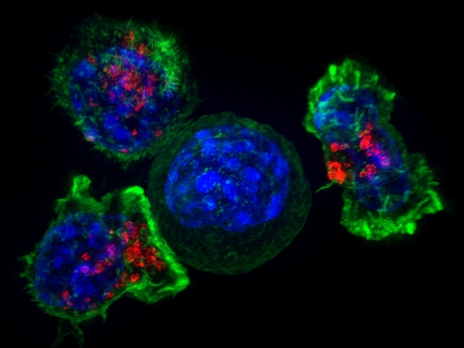
T cells ganging up on a tumour cell 
The American Society of Clinical Oncology’s (ASCO) annual review always makes for interesting reading. Immunotherapy continues to feature large [ASCO 2017 Annual Report again picks immunotherapy as “Advance of the Year"] , with adoptive cell immunotherapy being named “Advance of the Year”.

This bespoke treatment involves genetic manipulation of the patient’s own T-cells, in which an engineered virus is used to insert DNA encoding a protein capable of recognising unique molecules present on the surface of tumour cells. Transformed cells expressing chimeric antigen receptors (CAR) are cultured in the laboratory and then infused back into the donating patient. CAR-T cells then seek and destroy cancer cells. Being a “living therapy”, CAR-T cells continue to multiply to exert a persistent anti-tumour effect.

While the number of patients who have received CAR-T therapy to date is still in only in the hundreds and largely limited to certain haematological cancers, clinical response results certainly justify the ASCO accolade.  Kymriah® (Novartis), the first adoptive cell immunotherapy to receive FDA approval, achieved unprecedented response rates in children and young adults suffering from relapsed or refractory acute lymphoblastic leukaemia (ALL).  Over 80% of Kymriah® treated patients went into remission within 3 months, with 75% remaining still in remission after 6 months. 

Impressive study results have been reported for another hard-to-treat blood cancer, relapsed or refractory diffuse large B-cell lymphoma (DLBCL). Response rates to available treatments are less 10%, with survival measured in months. Complete response rates were 40% and 30% after 1 and 6 months, respectively. Moreover, treatment raised the probability of being relapse-free at 6 months to almost 74%. Another FDA approved CAR-T therapy, Yescarta® (Kite Pharma, recently acquired by Gilead) has also shown achieved complete and durable complete responses in DLBCL and other forms of B-cell lymphoma.

The major challenge of CAR-T treatment is management of potentially life-threatening adverse effects, which are a direct consequence of the engineered anti-tumour response, with the most serious being “cytokine storms” resulting from release of potent inflammatory molecules (including IFN-γ, IL-10 and IL-6). Some degree of neurotoxicity is common in recipients, although the long-term consequences of this are unknown.

Other significant challenges are logistics and cost: as personalized living therapies, cell collection, transformation, expansion and delivery to the patient is a complex series of steps, with consistent manufacture of a safe and reliable product being the most demanding. While the list prices of Kymriah® and Yescarta® are $475,000 and $373,000, respectively (Novartis offers a rebate where patients do not respond to treatment), side effect management and other support costs can bring the total medical bill close to $1.5 million per patient. This, and complex reimbursement issues, are at least in part, factors in the low uptake of CAR-T therapy. Better definition of cost-effectiveness is needed.

Despite these challenges, a variety of investigational adoptive cell immunotherapies is in the works for cancers other than B-cell malignancies, with studies underway in multiple myeloma (Bluebird Bio, Kite Pharma); ovarian cancer (Juno Therapeutics), and glioblastoma (Mustang Bio, Aurora Biopharma). Several “next generation” candidates incorporate drug-sensitive “safety switches” that allow the anti-tumour response to be turned on or off.

Moving from bespoke to “off the peg” therapy using cells collected from healthy donors (“allogeneic” cell therapy) could substantially reduce the overall cost of cellular immunotherapy. Early clinical studies with an allogeneic CAR-T cell product developed by Cellectis are underway.

Cellular immunotherapy development has proved to be a rocky road. Clinical study deaths have resulted in the abandonment of a CAR-T candidate by Juno Therapeutics [CAR-T: A wheel falls off, but still rolling], and clinical trial holds imposed on Cellectis (although recently lifted) and as of this week, Bellicum Therapeutics, with three unexpected deaths occurring in subjects under treatment for haematological cancers. Growing experience may allow early identification of study subjects at increased risk of severe adverse events or development of safer investigational treatment regimens.

Commercial success could prove elusive for several developers with high product cost, small addressable patient populations, safety issues, and competition from both cellular and non-cellular immunotherapies, particularly in the B-cell malignancy segment, constraining uptake. Giants such as Novartis can afford the necessary infrastructure, flexible pricing and slow rate of uptake, but smaller players may join Kite Pharma and Juno Therapeutics in being acquired by companies with deep pockets.  

Photo credit: NCI/NIH, Alex Ritter, Jennifer Lippincott Schwartz, and Gillian Griffiths